


What's a TD filter?




Don, I received the woofer TD filter today - thanks again for putting that together for me.
I've gotta run to practice, but I thought I would at least post a quick imped sweep of the woofer with the filter:
I'll do the pulse testing later tonight if I have time.
Last edited by Alien_Shore; October 2nd, 2025 at 04:06 PM. Reason: change pic host
- Mike

What's a TD filter?
A gi-normous chunk of copper wire and little plastic cylinders
Time Delay
- Mike

cradeldorf
Most XO filters , Butterworth , etc have time delays that vary with freq. this is not what we want.
The Bessel filters have constant delay and are what the Dr ordered.
We hope to delay the low freqs , all of them, by the same delay to match the high freq delay caused by the driver being behind the woofer.
And if we are lucky, this filter will not only provide the proper amount of delay, it will have a frequency response that rolls off the high freqs to match our hi freq filter.
Don
Pano -
I swore that you posted recently about using Holm to detect timing delay of different drivers in a system.
The board's search indexes apparently haven't been updated since JUNE so the search function isn't working worth a crap!
Can you tell me how you use Holm to do that? I don't have a 'scope, and the DATS scope is rather limited in functionality - I can't split the input between devices, so the method that Don is describing and asking me to do I'm at a loss.
- Mike
I still can't get the DATS scope to do what I want it to, but I went ahead and took some test screen shots anyway for you all to look at.
First is the scope of the woofer only (through the TD filter) with the test chirp signal:
Second is the HF horn only with the same test chirp signal:
Last is the combined woofer and HF horn:
The amplitude seems to only increase when the woofer and HF play simultaneously, versus getting "messy".
But I'm not sure what else I can deduce from this without being able to trigger directly from the amp signal and compare...
Last edited by Alien_Shore; October 2nd, 2025 at 04:43 PM. Reason: change pic host
- Mike

As a layperson who's been watching this thread with interest, I'd say it looks like you're there.
It would be interesting to compare those shots with similar shots using a standard n-1200 crossover without the TD circuit.
eso
Mike
I think eso is right.
Could you change the scope horiz time base by 6 or 10 to blow up the image ?
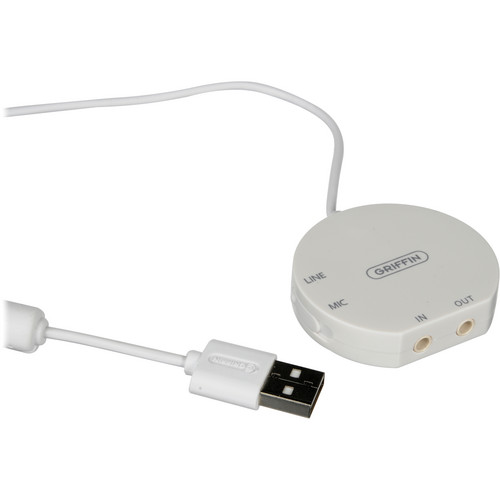
Re splitting the input... I use a small A to D converter to get my analog L&R to USB. It looks like a double stuff Oreo with a tail. The tail is a USB cable and the cookie has two 1/8" stereo jacks one for Line and one for Mic. I got one from the Apple Store and another from Goodwill.
Don
Like one of these?Originally Posted by donaldpatten

Griffin Technology iMic USB Audio Interface GC16035 B&H Photo
eso
"They were a carnival of American decay on parade, and they had no idea of the atrocity they had inflicted upon themselves"-- Henry Chinaski
Thanks guys - I agree that we are just about done here; what remains is more academic in terms of precision of measurement.
Here's the scoop on the DATS oscilloscope. It is "dual channel" but limited. One of the channels is fixed on the internal "reference signal" (signal generator), while the other is selectable (you can use the DATS test leads to probe an external signal, or you can point to the software audio device selected for use as input to DATS - normally the sound card or mic pre-amp). Since my crappy laptop only has two USB 1.0 ports, which are both filled by the USB mic/preamp, and the USB sound card, I didn't have an empty port to use the DATS test leads. One last thing I can try is to find a USB bus and get another port going, or try to use the laptop internal sound chip and free the USB port up.
And yes Don, I can adjust the scope base time and take a few more screen shots. Will try that this evening.
Eso - the 604E runs stock on the N1500 XO. Unfortunately, the speaker I bought didn't come with the XO, so I can't test it with the N1500, unless someone wants to mail one over.I have the schematic (it's a very simple circuit) and could slap one together...
- Mike
 Posting Permissions


Bookmarks